
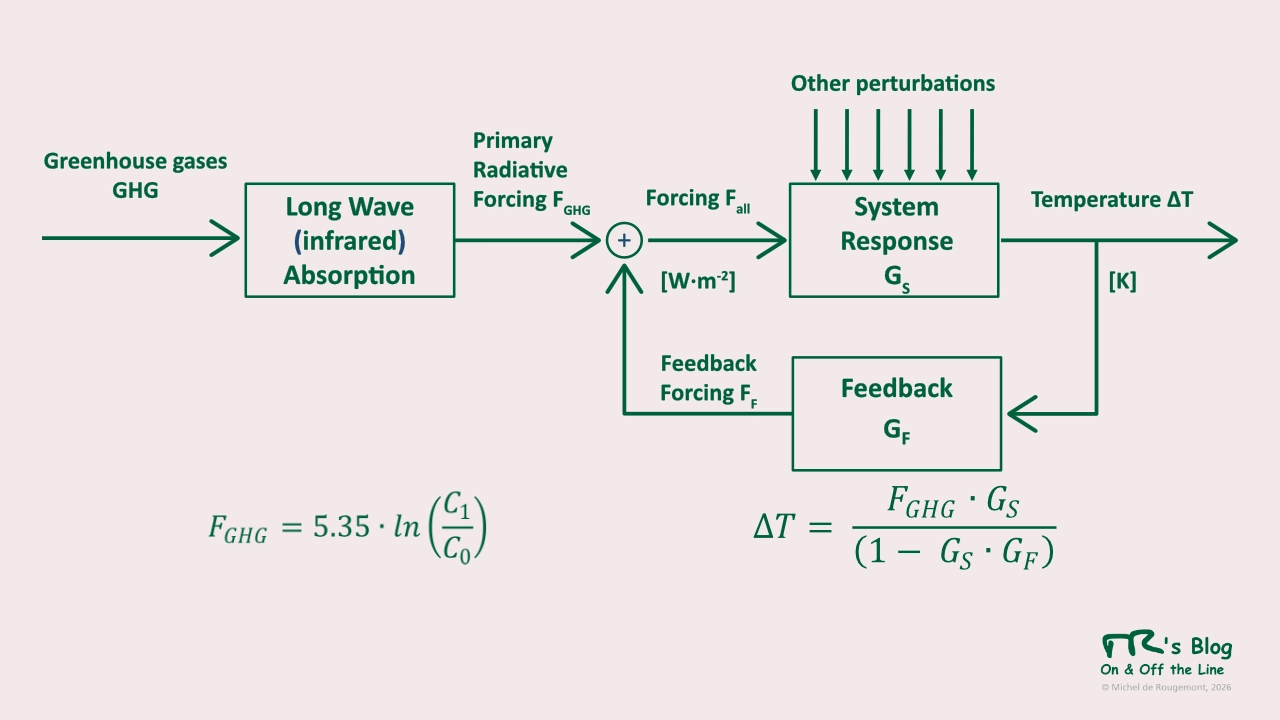
The thesis of human-induced global warming holds that the current rise of the air temperature at the Earth’s surface is attributable to emissions of greenhouse gases (GHGs) into the atmosphere. These emissions are primarily linked to the consumption of fossil fuels. Although this theory is based on sound physical principles and observational data on these emissions, the current estimate of temperature sensitivity to GHG concentration (equilibrium climate sensitivity, ECS) remains within a wide range, from 2 to 5 °C, assuming a doubling of concentration (1).
In a previous article (2), a model used to estimate ECS contained an error that produced a result which significantly underestimated this sensitivity. The paper presented here corrects this error. However, it highlights the physical inconsistency of the formula generally used to calculate a simple system that takes into account the energy balance around our planet and the feedbacks to the radiative forcing induced by greenhouse gases accumulating in the atmosphere.
To simplify this point, one need only take a moment to consider this formula, given on page 993 of the latest IPCC report:

ECS corresponds to the value obtained if the concentration of CO₂ were to double, which it has only done by half since the start of the industrial era, rising from 280 to 423 ppm.
This equation therefore implies that, in the absence of feedback or if feedback were very weak, the climate would respond hypersensitively to any forcing, approaching infinity if α=0, which makes no physical sense. By estimating ECS using the standard method employed by systems engineers, as illustrated in the diagram at the top of this article, the value of ECS would only become critical for very positive feedbacks, which is not and has never been the case.
‘A technical detail,’ some might say, ‘mere nit-picking, since the values estimated in this way are of the same order of magnitude.’ But this overlooks the wide range of ECS estimates provided by all climate modellers. This science is not exact, even though it describes all phenomena. Quantifying the undeniable role played by greenhouse gases remains an unresolved challenge. Combined with extreme scenarios, all possible future projections are on the table, even the most implausible ones that fuel the prevailing eco-anxiety.
This purely mathematically hyperbolic perspective also tends to manifest itself in the hyperbolic language used by alarmists, who see the imminent arrival of a point of no return (tipping point).
The media hysteria that accompanied this year’s heatwaves in Western Europe is a manifestation of this.
Within the solar system, the palaeontological history of our planet teaches us that it nevertheless possesses a great capacity for homeostasis. We would not be here to discuss it if this were not the case.
An Excel spreadsheet containing the calculations relating to the data presented can be downloaded here.
References:
1. Intergovernmental Panel on Climate Change (IPCC). Climate Change 2021 – The Physical Science Basis [Internet]. Cambridge University Press; 2023. Available from: https://www.cambridge.org/core/product/identifier/9781009157896/type/book
2. Rougemont M de. Equilibrium Climate Sensitivity. An estimate based on a simple radiative forcing and feedback system. 2016;1–8.
Merci de partager et de diffuser cet article !