

Since 2010, the small scientific community dedicated to climate modelling has been working to define scenarios against which each model can provide projections. To establish Representative Concentration Pathways, assumptions are made regarding the possible development of global demographics, the economy, technologies and energy consumption. Series are established concerning the hypothetical concentrations of various greenhouse gases and their corresponding radiative forcings. This will serve as the input for running climate models to simulate the future, for the IPCC to evaluate the results.
It is essential that valid comparisons can be made between different models; this is why results must be produced based on the same assumptions. Originally, five trajectories were selected, including the well-known ‘high greenhouse gas emitting’ RCP8.5, the number containing the acronym indicating the radiative forcing (8.5 W/m²) to which this scenario would lead by 2100. IPCC experts have also designated it as a ‘high-reference scenario without additional climate policy’. Testing an extreme scenario—in this case, a very pessimistic one—is always of interest to modellers as it allows them to verify the consistency of their results. Low-intensity scenarios are also of interest as they allow to test the extent to which weak signals can emerge from high natural variability. All of this is aimed at improving the quality of the models.
This scientific approach ends there.
To declare this RCP8.5 as ‘business as usual’ is to paint the devil on the wall. If it is described as business as usual with high energy intensity and the unchecked continued use of fossil fuels, that does not make it plausible. Yet all climate activists have done so, driven or followed by the media, whose job is to generate the greatest possible anxiety, to the point where they themselves have come to believe it. The climate policies set out in the 2015 Paris Agreement are based on this belief.
In preparation for the reference data used by the IPCC to draft its sixth report, AR6, in 2021, five other scenarios were published in 2017: the Shared Socioeconomic Pathways (SSPs). SSP5-8.5 is the worst-case scenario, based on a massive resurgence of coal and oil. The catastrophic projections resulting from this have also served as justification for the most stringent climate policies – or the most ambitious, from an alarmist perspective. ‘Carbon budgets’ have been defined and commitments made. It is in the name of this scenario that courts are being called upon to condemn the inaction of states or to punish companies (e.g. the cement manufacturer Holcim) that are alleged to be knowingly contributing to the expected collapse.
What’s new?
The IPCC’s seventh report is currently being prepared and is due to be published in 2028. For this report, researchers are being asked to reveal the results of their models, but this time based on new scenarios that have just been published by a panel of 45 experts from 45 institutions across 18 countries. Russia is notably absent, even though it is one of the world’s largest producers of fossil fuels and interesting models are published there; yet it participates in the Coupled Model Intercomparison Project (CMIP). China has only one representative, despite being the world’s largest consumer of fossil fuels. A core group of around ten prominent members from this group participated in previous generations, including the lead author Detlef P. Van Vuuren, from the Dutch PBL Netherlands Environmental Assessment Agency[1]. Reto Knutti from ETH Zurich is among them. Without wishing to imply any incompetence on the part of this group, it must be noted that the institutions from which they come are all dedicated to climate engineering, modelling and projections of all kinds. There are no experts in demography, economics or medical sciences. It is the institutionalised cream of a specialised and particularly exclusive elite. And yet, the prediction of the world’s future depends on it.
In this new series, ‘ScenarioMIP-CMIP7’, the previous extreme scenarios (RCP8.5, SSP5-8.5 and also SSP3-7.0) are no longer included as they have lost their plausibility. Also, a technical detail but an important one: unlike previous versions, which provided lists of greenhouse gas concentrations in the atmosphere, these new scenarios specify only emissions into the atmosphere, without making assumptions about the subsequent evolution of concentrations in the air (currently, around 45% of CO2 emitted by human activity accumulates in the atmosphere, with the remainder being absorbed by the oceans and biomass). However, it is not clearly stated that a new procedure has been defined in this way.
Seven scenarios are defined: (H) High, (HL) High-to-Low, (M) Medium, (ML) Medium-to-Low, (L) Low, (LN) Low-to-Negative and (VL) Very Low.
The High scenario is substantially lower than previous extremes as it reflects changes in technology and demographics. The Medium scenario is pessimistic.
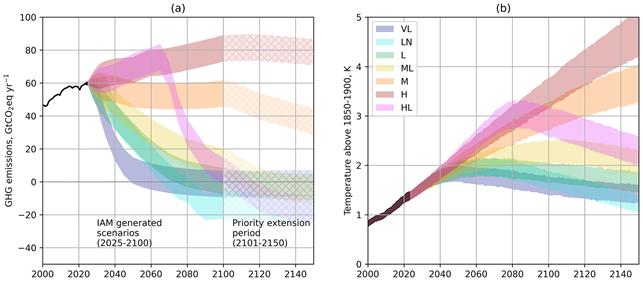
(a) total emissions, gigatonnes per year expressed in CO₂ equivalent
(b) resulting temperature increases relative to the 1850–1900 average (according to a preliminary rough estimate)
Source: Detlef P. Van Vuuren et al., doi.org/10.5194/gmd-19-2627-2026
As a reminder, the previous worst-case scenario SSP5-8.5 ( Shared Socioeconomic Pathways ) projected maximum emissions of 130 Gt/y for CO₂ alone and a global temperature increase of 4.4 °C by 2100.
So, what is going to happen?
Climate sceptics are rejoicing; they are calling for an immediate end to emergency climate policies and energy transitions. As for those who deny the human cause of global warming, they couldn’t care less.
The former are wrong, as usual one might say; the latter are of no consequence, as is the case with all certainties.
Let us remember that this revision of the script is long overdue; it was already necessary over ten years ago, at the dawn of the sixth generation of IPCC reports. This abandonment of extreme and implausible scenarios should, in my view, somewhat reduce the sense of urgency and the need to maximise mitigation efforts.
As the initial estimates show, the new set of scenarios will produce a vision of the future that is slightly less catastrophic but still alarming. For ultimately, even if the scientific basis for the urgency is weakened, this changes nothing in the official orthodoxy: the predominance of the human component of global warming remains unchanged; the costs incurred by this warming remain considerable; adaptation is not favoured as it does not address the cause; greenhouse gas emissions remain the culprits and therefore a climate mitigation policy aiming for ‘net zero’ is essential, the sooner the better.
Of the seven new scenarios, we can be sure that only the High scenario will be adopted as the basis for climate policy. This means that an expected warming of 3.5°C by 2100 will have to be regarded as just as catastrophic as the 4.5°C of previous reports. It is very easy to argue this case since it is not based on any facts. Uncertainty allows for everything and its opposite. Furthermore, according to Roger Pielke Jr., the Medium scenario does not correspond to current policies; it overestimates emissions, which leads to excessively high temperatures.
There is a political circularity to this approach: after a 1.5 °C target was agreed by treaty, the scenarios were revised accordingly. But in turn, this choice of scenarios is designed to validate the policies. Only a change in methodology can break this vicious circle.
It would, however, be sensible to take our foot off the accelerator of a machine that is barely moving. Reducing the use of fossil fuels – otherwise known as “energy transition”– is already costing “a crazy amount of money[2] “ but is progressing at a snail’s pace[3] . By spending less and redirecting these funds towards necessary adaptation measures, the climate trajectory will no longer be dramatic or tragic. And this so-called transition would not have to be carried out using technologies as inefficient and unreliably available as solar and wind power.
Yet it is likely that this rational strategy—the only one that is morally defensible—will not be adopted simply because the worst-case scenario has become slightly less dire. Whilst it is encouraging that the small community of experts has finally opened up to necessary corrections, the way it operates and the dependence in which it holds the political and media worlds captive will not be altered by this.
And beyond the realm of expertise, a new economy has emerged that cannot tolerate being challenged. A comparison springs to mind with airport security checks: no one dares to reform them. The same applies to the climate business, but on a much larger scale. The scientific community, experts of all kinds, companies and investors subsidised through Pigouvian taxes, authoritarianism and certifications, industries freed from the constraints of competition, an expanding state footprint, and media hype: the stakes have become colossal, so it is highly unlikely that they will give them up. The almost complete lack of media coverage of this recent correction proves it.
Political climate alarmism therefore still has a bright future ahead of it, before its futility is demonstrated. The politicians in charge need to change, so that reason can become the moral compass.
[1] Regarding integrated assessment models (IAMs), which combine economics, energy systems, and climate science, six main institutions are involved:
IIASA International Institute for Applied Systems Analysis, Laxenburg, Austria
PIK Potsdam Institute for Climate Impact Research, Potsdam, Germany
PBL Planbureau voor de Leefomgeving (Netherlands Environmental Assessment Agency), The Hague, Netherlands
PNNL Pacific Northwest National Laboratory, Richland / College Park, USA
NIES National Institute for Environmental Studies, Tsukuba, Japan
FEEM Fondazione Eni Enrico Mattei, Milan, Italy
[2] According to the International Energy Agency (IEA, World Energy Outlook 2025), the annual energy investments required to achieve net zero by 2050 must rise from USD 3.3 trillion to USD 4.8 trillion per year by 2030.
McKinsey (2022) estimates total expenditure on physical assets at USD 9.2 trillion per year, including USD 3.5 trillion in additional net investment. This is equivalent to half of global corporate profits. By way of comparison, global GDP is approximately USD 100 trillion.
[3] See my article on this subject, ‘The Improbable Carbon Neutrality’https://blog.mr-int.ch/?p=12046
Merci de partager et de diffuser cet article !